
the hand we're dealt
If I had to relate the last 6 months of trades to anything, it would be the Goliath rollercoaster in my hometown; a slow and steady ascension followed by a terrifying drop off that’s seemingly going in perpetuity. If you’re a dividend investor, while you took losses on your passive income recently, the game plan doesn’t change much. When you focus on cash flow from dividends you still get paid every month, year, quarter, whatever. Moving forward though, where futures are unpredictable, where can we invest to capitalize on the situation?
The Doom Loop
Baby Boomers.
- Average age: 66.
- Amount of money in their pensions: Much.
- About to what? Retire.
Pensions exist for spending when you retire, but prior to that, that money is invested into either the stock market or the credit market, where companies borrow money by issuing bonds. The bonds are sought and bought because of the yield and everything is fine and dandy until the economy slows down. The problem is that over the last 5 years, as boomers are slowly selling off their stock to fund their retirements, companies are the main source of buyers in the stock market, buying back their own shares. Millennials though mostly flirting with index funds aren’t really buying stocks and truthfully, most people aren’t. When companies don’t have cash to pay debts during a recession, they ultimately stop buying back their shares and additionally, less are paying taxes so less are buying bonds.
In An Ideal Situation…
The free market would allow prices to adjust so those with little to no assets can buy equities at cheap valuations, so there can be at least some expected return in the future. But that’s not the case. Millennials are stuck with all-time high valuations in equity markets, minute interest rates from bonds and high prices on property.
The Hand We’re Dealt
The government will not allow the some ~75 million baby boomer voters (who are also, basically, the demographic of the government) to go bust. They will be supported at all costs. As debt has grown massively over the past 40 years due to decreased interest rates, a problem arises. Companies that can’t service their debts and ultimately go bust invite an insolvency crisis. Unemployment rises, and pension plans deteriorate. Rather passing blame and instead just facing the reality of the situation, it’s clear millennials aren’t inheriting an ideal financial market.
Insert: Crypto.
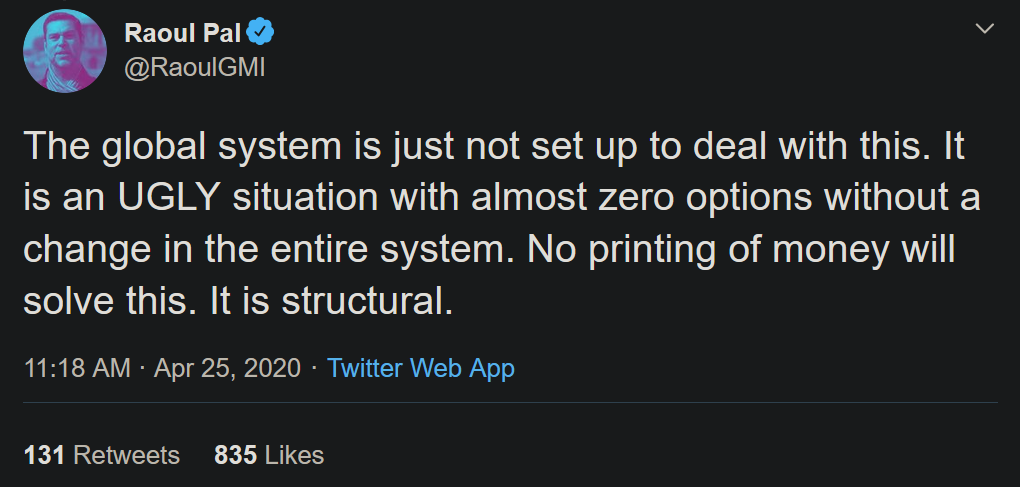
This analysis is largely from concepts propagated by Raoul Pal. I’m a huge fan of his financial outlook and I encourage those looking for a better understanding of macroeconomics to study his work. He recommends The Bitcoin Standard and encourages people to understand why bitcoin is a great asset for savings. There is a low probability of btc going to zero and while a possibility to fall drastically obviously exists, there is also a possibility of significant return.
There is an opportunity of asymmetric risk here. It’s as if you use a wooden plank to move a giant stone. Sometimes the wood will snap, but there will be times the stone moves.
In a scenario where a young adult has 5k in savings and is not inclined to invest in stocks because of valuations; they can afford to be wrong on btc. There is time to recover, and considering a long period of time, it’s possible to see btc contribute well to a retirement fund.
If you’re another type of investor, though, say real estate, dividends, index funds, etc…then what? During a recession, prices fall, and it’s ideal to have cash on hand. Especially considering financial institutions likely to follow Chase suite when it comes to requiring lenders to have 20% down and a 700+ credit score. Consider Buffet sitting on $137 billion in cash, it might be ideal to open fewer long positions at the moment.